


Centrifugal Pump
ROLWAL: a Professional Centrifugal Pump Manufacturer
Our company was established in 1990 and is located in Daxi, the hometown of pumps in China. We have self-operated import and export rights.
Variety of Products
We can provide customers with various types of water pumps, welders, and motors, such as centrifugal pumps, peripheral pumps, self-priming jet pumps, deep well submersible pumps, submersible sewage pumps, MMA welding machine, MIG welding machine, TIG welding machine. We can also provide portable car battery chargers.
Professional Production Equipment
Our factory is equipped with many types of equipment, including production lines, processing centers, testing centers, etc. We have also arranged professional production personnel to monitor all aspects to ensure the high quality of each product.
Rich Market Experience
Our company has established export trade relationships with customers in many countries and regions, and our products are sold to the Middle East, Southeast Asia, Europe, Africa, South America and other places. Our products have received favorable comments from many customers.
Multiple International Certifications
Various products such as water pumps, welding machines, and motors we produce have passed ISO9001 and CE certification. At the same time, we have professional design and production teams that continuously develop and innovate new products.


Brief Introduction to Centrifugal Pumps
Centrifugal pumps are among the most widely used types of pumps in various industries. They are designed to move liquids from one place to another by converting mechanical energy from a motor into kinetic energy, which drives the fluid through the pump and into the discharge pipe. Centrifugal pumps are mechanical devices used to transport fluids by converting mechanical energy from an external source (e.g., an electric motor) into kinetic energy in the fluid being pumped. The mechanism of a centrifugal pump is relatively simple. It consists of three main components: an impeller, a casing, and a shaft. The impeller is a rotating component that contains blades or vanes that move the fluid. The casing is a stationary component that surrounds the impeller and guides the fluid to the discharge point. The shaft connects the impeller to the motor that rotates it. Centrifugal pumps are commonly used in industrial, domestic, and agricultural applications due to their versatility, simplicity, and efficiency.
How a Centrifugal Pump Works
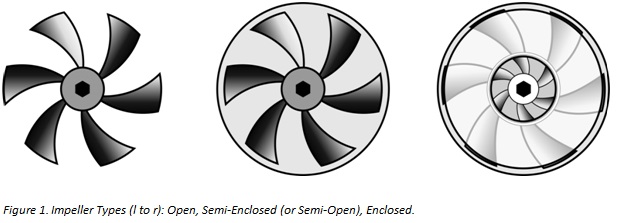
The impeller is the key component of a centrifugal pump. It consists of a series of curved vanes. These are normally sandwiched between two discs (an enclosed impeller). For fluids with entrained solids, an open or semi-open impeller (backed by a single disc) is preferred (Figure 1).
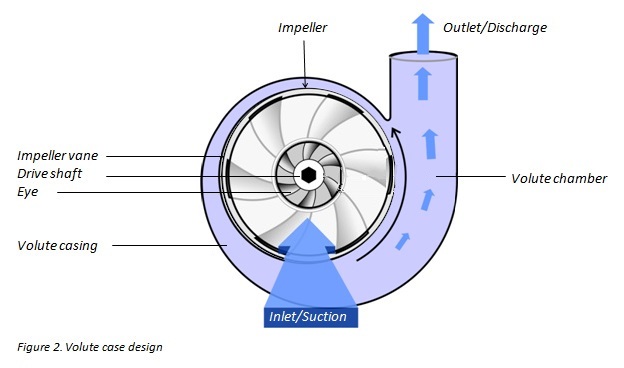
Fluid enters the impeller at its axis (the ‘eye’) and exits along the circumference between the vanes. The impeller, on the opposite side to the eye, is connected through a drive shaft to a motor and rotated at high speed (typically 500-5000rpm). The rotational motion of the impeller accelerates the fluid out through the impeller vanes into the pump casing. There are two basic designs of pump casing: volute and diffuser. The purpose in both designs is to translate the fluid flow into a controlled discharge at pressure. In a volute casing, the impeller is offset, effectively creating a curved funnel with an increasing cross-sectional area towards the pump outlet. This design causes the fluid pressure to increase towards the outlet (Figure 2).
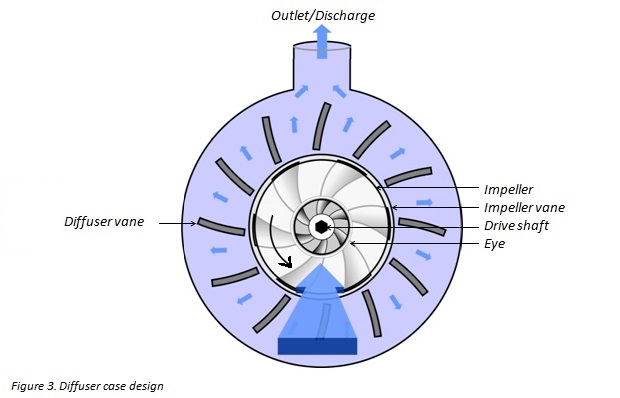
The same basic principle applies to diffuser designs. In this case, the fluid pressure increases as fluid is expelled between a set of stationary vanes surrounding the impeller (Figure 3). Diffuser designs can be tailored for specific applications and can therefore be more efficient. Volute cases are better suited to applications involving entrained solids or high viscosity fluids when it is advantageous to avoid the added constrictions of diffuser vanes. The asymmetry of the volute design can result in greater wear on the impeller and drive shaft.
Components of Centrifugal Pumps
Centrifugal Pump Shaft
It is the central part of the pump which rotates together with the impeller when connected. The shaft is linked to the prime mover in order to get the power. The shaft fits perfectly with the ball bearing.
Centrifugal Pump Impeller
It comprises an arrangement of backward curved vanes. It is mounted to an electric motor’s shaft. This is known as the rotating part of the centrifugal pump enclosed in a casing that is watertight. The impeller rotates and imparts velocity to a liquid.
Centrifugal Pump Casing
This is a passage surrounding the impeller, which will be airtight. It is made in such a way that the water’s kinetic energy discharged at the outlet is changed to pressure energy before the water leaves the casing and is delivered into the delivery pipe. It works as a cover so that it protects the system. The casing transforms the velocity developed by the impeller into a stable flow. There are basically three types of casings in centrifugal pumps namely volute casing, vortex casing and casing with guide blades.
Suction Pipe With a Strainer and Foot Valve
The suction pipe has two ends. The first end is connected to the pump’s inlet and one end is dipped into the water in a sump. At the suction pipes’ lower end, a foot valve is fitted. The valve only opens in an upward direction as it will be a one-way type. To prevent the entry of unknown and unwanted bodies into the suction pipe, a strainer is fitted at the end of the pipe.
Delivery Valve
The delivery valve also has two ends. One end is connected to the pump’s outlet and the other end delivers the water at a required height.
Types of Centrifugal Pumps
There are various methods to classify centrifugal pumps, including application, design code, impeller types and numbers, and so in. In this section, the most common ways to categorize centrifugal pumps are explained. It should be noted that a pump may be placed in two or more groups at the same time.
Accordingly, radial, Axial, and Mixed flow are three types of centrifugal pumps.
*Radial Pumps
In radial pumps, the fluid comes out of the impeller after 90 degrees of rotation relative to the suction. The most common centrifugal pumps are in this category. Fluid enters the horizontal suction flange and exits through a vertical outflow flange. So, the discharge is perpendicular to the shaft of the pump. This design is applied when there is a flow limitation and you want to raise discharge pressure. Therefore, radial design is high pressure and low flow rate pump. Most pumps utilized in the oil and gas industries fall into this category.
*Axial Pumps
In an axial flow pump, the fluid moves parallel to the shaft. This procedure resembles the working of a propellant. The most significant application of this pump is when there is a large flow rate and very little pressure head. For example, they are common in dewatering pumps and water circulation pumps.
*Mixed Pumps
As the name implies, in a mixed flow pump, the fluid flows mixing both radial and axial properties. So, that is a trade-off between axial and radial pumps. Mixed pumps operate at high flow rates with a decent increase in the head.
Two or more impellers can be utilized in the pump, depending on the requirements and on-site operating conditions.
*Single Stage Pumps
This pump has only one impeller and the highest increase in pressure head is 125 meters. The simple structure, stable operation, high speed, lightweight, small volume, high efficiency, large flow capacity, and easy maintenance are essential advantages of single-stage pumps. Single-stage centrifugal pumps can be classified into horizontal pumps, vertical pumps, single-suction pumps, and double-suction pumps. The single impeller is designed to be useful for a large flow rate and relatively lower pressure head.
*Multistage Pumps
The fluid pressure at the outlet of the pump can be very large. Therefore, if a very high head at discharge is needed, the multistage pump is used. In this design, impellers are connected in series to increase the fluid pressure at each stage.
Regarding the use of code for pump types, the following two cases are usually used.
*API 610
This design is mostly used in oil and gas, petrochemical, and related process industries.
*ISO 5199/ISO 2858/DIN 24256
DIN 24256 is now integrated with ISO 2858. These standards are utilized for all pump design types.
Pumps are divided into two categories, single-volute or double-volute, depending on their casing type.
*Single Volute
In a single volute casing, the flow is discharged from the impeller into one volute, which winds completely around the impeller. This casing has one cut-water that delivers the fluid flow towards the outlet of the pump. Most of the pumps in the refinery are of single volute types.
*Double Volute
A double volute casing has two cut-waters positioned 180 degrees apart. Double volute has a benefit over the single. It minimizes the defection of the shaft when the pump works outside the BEP best efficiency point (BEP).
Most centrifugal pumps are single-suction designed; however, sometimes it is necessary to have double-suction designs.
*Single Suction
In a single-suction centrifugal pump, the fluid flows into the inlet, and the entire liquid immediately flows into the impeller eye (the inlet of the impeller). The centrifugal force then produces pressure as the water leaves the impeller.
*Double Suction
Single-suction will not suffice when the flow rate is too high. In this case, double suction centrifugal pumps are used. The impeller of this pump is engineered so that fluid enters from both sides in comparison with the single side in a normal case. However, the name “double suction” must not confuse you. Even in the double suction design, there is only a single suction and discharge flange. The difference is in the design of the impeller and casing.
Radially and axially split pump casings are two different designs discussed below:
*Radial Split
If a centrifugal pump casing has a vertical connection to the shaft (perpendicular to the shaft and parallel to the impeller), this is a radially split casing.
*Axial Split
An axially split casing of a centrifugal pump has a design in which the casing is split along the centerline of the shaft. The casing is divided into two halves that are separated horizontally, parallel to the shaft axis.
Accordingly, centrifugal pumps have either vertical or horizontal shaft positions.
*Vertical Shaft
In a vertical pump, the shaft is in a vertical orientation, and the pump is usually placed in the sump. These pumps are used in limited spaces. For example, pump in borewell and sump collection are of this type.
*Horizontal Shaft
Horizontal pumps are more commonly used because they are easy to maintain. In this type, the shaft is positioned horizontally.
Accordingly, centrifugal pumps are classified into overhung impeller pumps and between bearing pumps.
*Overhung Impeller Pump
In an overhung impeller pump, the impeller is installed on the end of a shaft, which overhangs its bearings. In this pump, the impeller is suspended through a single bearing. This configuration facilitates both vertical and horizontal installation of the pump.
*Between Bearing Centrifugal Pump
In between bearing type of centrifugal pump, the impeller is placed on the shaft, and the shaft is suspended at both ends between two bearings. Horizontal multistage pumps are provided in this design.
The benefits of centrifugal pumps include:
There is reduced friction in the pump.
Magnetic coupling breaking the pump will not overload and will also not get damaged.
Corrosion Resistance – The pumps allow processors and manufacturers to transfer different types of fluids, even those that can quickly corrode the other pumps. The pumps even when used extremely well can offer a long service life. The pumps are able to withstand corrosive materials.
Energy Efficiency - Centrifugal chemical pumps rank high in energy efficiency in comparison to all the other pumping technologies. Their efficiency reduces costs both over the life span or in the short term of each unit.
Smooth Flow - Centrifugal chemical pumps avoid pulsing when some other pumps can produce a pulsing flow.
Proven Reliability - Centrifugal chemical pumps are the best choice when reliability is important. The pump should be evaluated on the construction and design and features in order to ensure the specified pump will be durable enough to operate in extreme conditions.
Low Maintenance -Due to the long life spans, some pumps may need to be frequently routine maintained, which can make them costly to operate. However, centrifugal chemical pumps have low routine maintenance requirements.
Size Versatility - Centrifugal chemical pumps are available in a wide variety of sizes.
Application Versatility- The same pump configuration is unsuitable for every application. With centrifugal chemical pumps, different configurations are there to provide solutions for multiple uses.
There is no heat transfer from the motor – An air gap separates the pump chamber from the motor thus providing a thermal barrier.
The absence of drive seals eliminates the risk of a leak. This means that hazardous liquids can be pumped efficiently without any spillages. Eliminating the drive seals is a way of getting rid of leaks, wear, friction loss, and noise and provides separation of fluid from the pump drive.
Centrifugal Pumps: Its Ten Different Industry Applications
Given their versatility, centrifugal pumps are among the most commonly used pumps in industrial applications. Following are the common industrial applications of centrifugal pumps:
Centrifugal pumps are commonly used in chemical plants to move fluids around. The fluid is typically moved from one tank to another or from one process to another. Centrifugal pumps can also pump chemicals from one location to another, such as from a storage tank to a reactor. Some common applications of centrifugal pumps in chemical plants include:
*Pumping Liquids: Centrifugal pumps are commonly used to move liquids around in chemical plants. They are often used to transfer fluids from one tank to another or from one process to another.
*Pumping Chemicals: Centrifugal pumps can also pump chemicals from one location to another. For example, they can be used to transfer chemicals from a storage tank to a reactor.
*Pumping Corrosive Fluids: Centrifugal pumps are often used to pump corrosive fluids, such as acids and alkalis. These fluids can damage other types of pumps, so centrifugal pumps are a good choice for these applications.
*Pumping Flammable Fluids: Centrifugal pumps can also pump flammable fluids, such as oil and gasoline. These fluids can be dangerous to pump, so it is essential to select a pump that is designed for these applications.
*Pumping Viscous Fluids: Centrifugal pumps can also be used to pump viscous fluids, such as sludge or pulp. These fluids can be challenging to pump, but the high-pressure application of centrifugal pumps makes it possible to pump them.
Centrifugal pumps are used extensively in agricultural applications. They are used for irrigation, transferring water from reservoirs or lakes to fields, and powering farm equipment such as tractors and combines. Centrifugal pumps are also used to spray pesticides and fertilizers on crops. Farmers rely on centrifugal pumps to keep their operations running smoothly. These versatile pumps can handle various liquids, including water, chemicals, and even sludge and sewage. Their simple pump design makes them easy to maintain and repair, essential in rural areas where access to skilled technicians may be limited. Centrifugal pumps are often used in irrigation systems to move water from lower elevations to higher ones. The pump uses centrifugal force to create a water-lifting action, which helps move the water up and out of the irrigation system. These pumps are often used in conjunction with other pumps, such as submersible pumps, to ensure that the entire irrigation system functions correctly. By using a combination of different types of pumps, farmers and other users of irrigation systems can be sure that their crops will receive the proper amount of water, even during periods of drought or other dry conditions.
Centrifugal pumps are widely used in water treatment plants for various applications. Typically, they are used to move water from one location to another or circulate water within the plant. In some cases, centrifugal pumps are also used to provide high-pressure jetting for cleaning pipes and other surfaces.
*Filtration Applications: Centrifugal pumps are commonly used to move water through filtration systems. They can provide the necessary pressure to push water efficiently and at high flow rates, even against strong resistance from filters and other components in the system.
*Disinfection Applications: In addition to their ability to move large volumes of water with relative ease, centrifugal pumps are ideal for disinfecting water due to their rugged construction and resistant nature against corrosion and wear over time. Many municipal plants rely on centrifugal pumps, particularly when treating wastewater before discharging it into lakes or rivers, where its quality must meet specific standards.
*Saltwater Desalination: Centrifugal Pumps are in saltwater desalination plants. They are used to move large volumes of water through the plant’s filtration system to remove salt and other impurities. This is a critical process for making seawater safe for human consumption or other uses, and centrifugal pumps ensure that the water is adequately filtered and purified.
Centrifugal pumps are commonly used in oil refineries to transfer liquids between process units. The oil industry typically uses two types of centrifugal pumps:
*Process Pumps: These pumps are designed to handle highly viscous oils and other liquids with solids content.
*Utility Pumps: These pumps are designed for general purpose use and can be used to transfer both light and heavy oils.
Utility pumps are typically used to transfer crude oil from storage tanks to the refining process units, while process pumps pump refined products from one unit to another. Both types of centrifugal pumps play an essential role in ensuring an oil refinery’s safe and efficient operation. Centrifugal pumps are also used in oilfields to transfer crude oil from the wellhead to storage tanks or transport it to pipelines. In addition, centrifugal pumps are used in offshore oil and gas production platforms to transfer liquids between process units and inject chemicals into the production wells.
Paper mills are one of the most common industrial applications of centrifugal pumps. They use centrifugal pumps to move paper stock through the pulping process. The paper stock is a fibrous slurry full of water and other liquids. The centrifugal pump helps to separate the solid fibres from the liquid and then moves the pulp through the system. Centrifugal pumps are also used in the wastewater treatment process in paper mills. The pumps help move wastewater through the system to be correctly treated and discharged. Pumps are an essential part of paper production, and they play a vital role in ensuring that the manufacturing process runs smoothly.
Because centrifugal pumps can handle large volumes of fluid and operate at high pressures, they are ideal for power plants. Centrifugal pumps circulate water in the cooling system, transport fuel oil and lubricating oil, and pump water from the condenser to the boiler. In addition, centrifugal pumps are often used as fire fighting pumps. The most common centrifugal pump used in power plants is the radial flow pump. Radial flow pumps are very efficient and can operate at high pressures. However, they are not well suited for use in low-pressure systems. Another type of centrifugal pump that is often used in power plants is the mixed flow pump. Mixed flow pumps are less efficient than radial flow pumps but can operate at lower pressures. Centrifugal pumps are widely used in power plants because they are reliable, efficient, and versatile. In addition, centrifugal pumps can provide years of trouble-free service with proper selection and maintenance.
One of the common industrial applications of centrifugal pumps is mining. Centrifugal pumps are commonly used in mining applications to transfer water from one location to another. They are also used to boost water pressure for various purposes, such as operating hydraulic equipment and washing down mining operations. In addition, centrifugal pumps can be used to create a vacuum, which is often necessary for suction dredging operations. Centrifugal pumps are also used in the processing of minerals. They can be used to transport slurry, or a mixture of water and solid particles, to a mineral processing plant. Once at the plant, the centrifugal pump can be used to transfer the slurry to various processing tanks and vessels. Centrifugal pumps are also commonly used in dewatering operations. This is often necessary for mining operations where underground caverns are being excavated. The centrifugal pump can be used to remove water from the excavation site so that the work can proceed more quickly and safely. There are many other uses for centrifugal pumps in the mining industry. For example, they can be used to provide cooling water for machinery, remove sewage and wastewater, and supply water for firefighting operations.
Centrifugal pumps are widely used in food processing plants for various applications. Some of the most common uses for centrifugal pumps in food processing include:
*Transferring liquids from one tank to another
*Recirculating liquids during processing
*Cooling liquids during processing
*Transporting liquids to and from storage tanks
Centrifugal pumps offer many advantages over other types of pumps due to their simple pump design, reliability, and ability to pump large volumes of liquid at high pressures. Additionally, centrifugal pumps can be easily customized to meet the specific needs of any food processing application.
Centrifugal pumps are widely used in military applications because they can move large volumes of fluids at high pressures. In addition, they are commonly used in aircraft fuel systems, shipboard hydraulic systems, and ground support equipment. Centrifugal pumps are also used in water purification plants and sewage treatment facilities. There are many different types of centrifugal pumps, each designed for a specific application. Some common types of centrifugal pumps used in military applications include:
*Aircraft Fuel Pumps: These pumps move fuel from the tank to the engine. They are typically made from stainless steel or aluminium and have a high-pressure rating.
*Shipboard Hydraulic Pumps: These pumps move hydraulic fluid around a ship. They are usually made from bronze or brass and have a high-pressure rating.
*Ground Support Equipment Pumps: These pumps move fluids around military bases. These pumps have a high-pressure rating and are generally made from solid elements like aluminium or stainless steel.
Centrifugal pumps are used for bilge pumping, fire fighting, water supply, and fuel transfer tasks. Centrifugal pumps can also be used to transfer sewage and other waste materials from one location to another. In addition, these pumps are often used to create a vacuum environment within a ship’s hull during construction or repairs. The most common applications are:
*Bilge Pumping: Bilge pumping is used to remove water accumulated in the bilge area of a ship. This water can come from rain or waves that have entered the ship. Bilge pumps are also used to remove water that has been spilt on the deck of a ship.
*Fire Fighting: Fire fighting pumps pump water to areas of a ship that are on fire. These pumps are often used with other firefighting equipment, such as hoses and sprinklers.
*Water Supply: These pumps are used to transfer freshwater from the ship’s storage tanks to the various areas of the ship that need it. This water is used for drinking, cooking, and bathing.
*Fuel Transfer: Centrifugal pumps transfer fuel from the ship’s storage tanks to the engines. These pumps are also used to transfer fuel from one tank to another.
*Waste Management: Centrifugal pumps can also be used to transfer sewage and other waste materials from one location to another. These pumps are often used in conjunction with a septic system.
8 Things to Consider When Selecting a Centrifugal Pump
In a perfect world, pump systems are inexpensive, long lasting, energy-efficient, and simple to maintain. Although there may be a perfect pump system for your specific processing application, there are still trade-offs you’ll make. Which should you budge on, and which should you leave as a priority when selecting a centrifugal pump?
Best Efficiency Point (BEP)
Before selecting a pump, you need to know what optimal pump performance looks like for your operation. One method is to determine the best efficiency point (BEP), which all pump manufacturers will provide. For example, a centrifugal pump should operate between 50-120% of its BEP for best long-term performance.
Range of Conditions
Just as crucial as BEP is knowing the full desired range of performance based on operating conditions. Flow rates, net positive suction head (NPSH), pressure ratings, and temperatures, are a few examples. The point is to know what you need out of the pump system before finding equipment that gives you desired results.
Margin of Error
Until the pump is operating in the real world, it’s hard to determine the exact performance standards you require. You should be able to have fairly accurate estimates to establish acceptable ranges. Even so, pad your expectations, so there is some margin for error. You may find a centrifugal pump that checks most boxes and is within an acceptable range. From here, you can dial it in with fine-tuning or customizations.
Process Materials & Conditions
Varying centrifugal pump applications is the reason for a handful of pump designs. Beyond the desired performance characteristics, you will also need to understand the pumped materials. There are fluids, natural gases, liquids with solid particulates, slurries, chemicals, and plain water. Some are acidic and corrosive, damaging seals and interior components, while others produce clogs and cavitation. Select the correct pump and construction materials that will handle the fluids and materials you are processing.
Environmental Conditions
Where you are planning to install and operate the pump system is also a significant factor. Consider whether it’s operating in outside, the temperature of the atmosphere it’s in, and humidity. Pump systems are designed to run effectively and efficiently for its environment - know what to expect for success.
Safety
Safety is another critical concern. You want a safe pump system that keeps your operators safe and the environment protected. Many operations are under strict environmental regulations and you want to avoid leaks to protect from contamination.
Maintenance
All pumps require routine maintenance - some more than others - based on the operating factors above. Understand the pump’s maintenance requirements and make sure you are not getting equipment that will end up providing more uptime rather than extended downtime for maintenance and repairs.
Customization
Most centrifugal pumps are designed to allow for customization. There are after-market solutions and alternative components that can be supplied by the pump manufacturer. The key thing to remember is that selecting the best centrifugal pump for you takes time, research, calculations, and planning.
Centrifugal Pump Maintenance Checklist
Maintenance Programs for centrifugal pumps can be grouped into three categories: routine, quarterly, and annual maintenance. Routine maintenance is the process of setting a schedule to inspect, log, and repair components. This focuses on components that are leading indicator of potential failure.
*Bearing and Lubricant Condition
Monitor and log bearing temperatures, lubricant level, and vibration. Lubricant should be clear with no signs of bubbling. If bubbling is occurring, this is a good indication to add more lubricant to decrease the temperature of the bearings. If there is an increase in vibration in the bearings, this may be a good indicator of impending bearing failure.
*Shaft Seal Condition
Check the mechanical seals. There should be no signs of visible leakage. During downtime, inspect the pump’s packing to make sure there is adequate lubrication. If the packing looks compressed and dry, replace the packing and add lubricant per the operation manual.
*Overall Pump Vibration
Imminent pump failure can be detected by monitoring overall pump vibration. Excessive vibration can result from a change in pump alignment, bearing failures, cavitation, and obstructions in the suction and discharge lines.
*Pump Discharge Pressure
The difference in pressure read by the suction and discharge gauges will provide the total developed head pressure of the pump. Confirm this reading is within the pump’s designed performance. You can find this on the manufactured website or your operation manuals.
*Verify the integrity of the pump’s foundation and check the hold-down bolts for tightness.
*For oil-lubricated pumps, as a rule of thumb, you should change the oil after the first 200 hours of operation for a new pump. Then again after every three months or 2,000 operating hours, whichever comes first. Your operation manual will have specific instructions for oil change intervals and oil grade.
*For grease-lubricated pumps, as a rule of thumb bearings should be greased every three months or 2,000 operating hours, whichever comes first. Your operation manual should have specific instructions for grease intervals and grease grade to be used.
*Grease the motor bearings according to the manufacturer’s instructions.
*Check the shaft alignment.
*Bearing vibration spectrum on all pump and motor bearings.
Keep a log of your pump’s performance at least once per year. Performance benchmarks should be established early on in the life of the pump. At a minimum, the benchmarking data should include head pressure, flow rate, motor amp draw, and vibration at each bearing. DURING ANNUAL MAINTENANCE, DISCONNECT AND LOCKOUT POWER TO INSPECT:
*Bearing Frame and Foot – Inspect for cracks, roughness, rust or scale. Machined surfaces should be free of pitting or erosion.
*Bearing Frame – Inspect all tapped connections for dirt. Clean and chase threads as necessary. Remove all loose or foreign material. Inspect lubrication passages to be sure that they are not blocked.
*Shaft and Sleeve – Inspect for grooves or pitting. Check bearing fits and shaft runout, and replace the shaft and sleeve if worn or if the shaft runout is greater than 0.002 inches.
*Casing – Inspect for signs of wear, corrosion or pitting. If wear exceeds a depth of 1/8-inch, the casing should be replaced. Check gasket surfaces for signs of irregularities.
*Impeller – Inspect the impeller for wear, erosion or corrosion damage. If the vanes are bent or show wear in excess of 1/8-inch deep, replace the impeller.
*Frame Adapter – Inspect for cracks, warping or corrosion damage and replace if any of these conditions are present.
*Bearing Housing – Inspect for signs of wear, corrosion, cracks or pits. Replace housings if worn or out of tolerance.
*Seal Chamber/Stuffing Box Cover – Check for pitting, cracks, erosion or corrosion. Inspect for any wear, scoring or grooves that might be on the chamber face. Replace if worn more than 1/8-inch deep.
*Shaft – Check the shaft for any evidence of corrosion or wear and straightness. Noting that the maximum total indicator reading (TIR) at the sleeve journal and coupling journal should not exceed 0.002 inches.
Our Certificate
Below are our certificate:


Our Factory
Below are our factory:


Ultimate Guide
Q: What are centrifugal pumps, and how do they work?
Q: What are the basic components of a centrifugal pump?
Q: What are the different types of centrifugal pumps?
Q: What are the advantages of using centrifugal pumps?
Q: What are the applications of centrifugal pumps?
Q: Why does centrifugal pump take too much power?
Q: What affects centrifugal pump performance?
Q: What happens when centrifugal pump is blocked?
Q: Can centrifugal pumps run continuously?
Q: Why should a centrifugal pump never be run empty?
Q: What is the limit of a centrifugal pump?
Q: How do you protect a centrifugal pump?
Q: How do you control the flow rate of a centrifugal pump?
Q: Can centrifugal pump increase pressure?
Q: What will happen if priming is not done in centrifugal pump?
Q: Why choose centrifugal pump?
Q: Can centrifugal pumps be reversed?