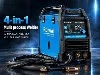
Choosing the best MIG welding setup for beginners involves considering several key factors that cater to ease of use, learning curve, and practicality. Here's a detailed guide to help beginners select the right equipment:
MIG Welding Machine:
Type of Machine: Opt for a basic MIG welder that is easy to set up and operate. A 110V or 120V machine is sufficient for beginners and allows for use with standard household power outlets. These are typically less expensive and more portable compared to higher voltage machines.
Wire Feed Mechanism: Look for a welder with a reliable and smooth wire feed mechanism. A stable wire feed is crucial for consistent weld quality and ease of learning.
Adjustability: Choose a machine that offers adjustable settings for wire speed and voltage. This adjustability allows beginners to fine-tune the welding parameters based on the material thickness and welding conditions.
Welding Gun and Accessories:
Quality of Welding Gun: Ensure the welding gun is comfortable to hold and maneuver. A lightweight gun with ergonomic features reduces fatigue during extended welding sessions.
Gas Regulator and Hose: Check that the welder includes a compatible gas regulator and hose for connecting to a shielding gas cylinder. Some entry-level models may come with a built-in gas valve and regulator, simplifying setup.
Shielding Gas:
Type of Gas: For beginners welding mild steel, a mixture of 75% argon and 25% carbon dioxide (C25) is commonly recommended. This blend provides good weld penetration and minimizes spatter.
Gas Cylinder Size: Start with a small to medium-sized shielding gas cylinder (e.g., 20 cubic feet or larger) that is easy to handle and transport. Ensure it is compatible with the regulator provided with your welder.
Consumables:
Welding Wire: Choose solid core welding wire appropriate for the materials you intend to weld (e.g., ER70S-6 for mild steel). A 0.030-inch diameter wire is versatile for welding a range of material thicknesses.
Contact Tips: Stock up on contact tips compatible with your welding wire size (e.g., 0.030-inch tips for 0.030-inch wire). These tips can wear out over time and affect welding performance if not replaced regularly.
Safety Equipment:
Welding Helmet: Invest in an auto-darkening welding helmet that adjusts quickly to changes in arc brightness. This improves visibility and reduces the need to lift the helmet during welding.
Welding Gloves and Clothing: Wear heat-resistant welding gloves and clothing made from flame-retardant materials to protect against sparks and UV radiation emitted during welding.
Learning Resources:
User Manual and Guides: Review the welder's user manual thoroughly to understand setup procedures, safety precautions, and troubleshooting tips.
Online Tutorials and Courses: Take advantage of online tutorials, instructional videos, and beginner welding courses to learn fundamental welding techniques and best practices.
Conclusion:
The best MIG welding setup for beginners balances ease of use, affordability, and quality. By selecting a reliable welder with adjustable settings, quality accessories, and appropriate safety gear, beginners can start learning MIG welding effectively. Remember to practice proper welding techniques and safety precautions to build confidence and proficiency over time.